|
N
|
 |
| Mount Tabor |
o one knows which mountain it was on which Jesus was
transfigured; but from the fourth century, the traditional site has been Mount
Tabor, smack in the middle of the Valley of Jezreel. Dome shaped, looking much as if an ethereal
ice cream scoop might once have scraped it from the crust of the earth and
plopped it down atop an otherwise level plain, Mount Tabor has been the
destination of pilgrims and tourists for centuries. Our bus took us from the Bedouin village at
the foot of the mountain to a parking lot perhaps a quarter of a mile up. We spilled out of the bus and into a half
dozen beat-up taxis, therein to be transported up the mountain in a series of
switchbacks, with nary a guardrail in sight.
Flying up the mountain at breakneck speed, our Palestinian taxi driver
knew how to handle his old Mercedes, and knew as well how to give travelers
fits. At every hairpin turn exclaiming,
“Hallelujah!” and chuckling, he had every one of us laughing and screeching
like kids on a roller coaster.
It didn’t do a lot for my devotional life. By the time we reached the windswept summit,
my major connection with the Transfiguration was the fact that we were white as
bleached sheets. I lamely suggested that
we build three booths and avoid the trip down.
But the trip is worth the effort, white knuckles and all. Atop the ruins of a fourth century basilica
(can you imagine hauling all the stone for a church up such a peak?) twentieth
century Franciscans built a magnificent edifice designed by the brilliant
architect Antonio Barluzzi. He depicted
the Transfiguration with bi-level altars.
The upper altar, reached by side stairs, beams with magnificent mosaics
like a jewel, symbolizing the divine nature of Christ. Below, is a much simpler altar, made to
recall Christ’s human nature. And in the
towers on the north and south sides of the church are two chapels, one for
Moses and one for Elijah.
It would be easy, and maybe a little cheap, to go down the
path of exploiting the irony of the church and its three naves, mirroring the
rather stupid remark of Peter suggesting the building of three booths, perhaps
for the Feast of Tabernacles. But
alternatively I would like to focus on how the Transfiguration of Christ, his
own seminal religious experience, if you will, and how it somehow called for
witnesses.
 |
| Statuary niches in the hillside at Caesarea Philippi, near the ancient shrine of Banias |
You have noticed, perhaps, that within the band of The
Twelve disciples there was an inner circle consisting of Peter, James, and
John. The first three gospels tell
several stories of how Jesus chose these three taking them with him on some
occasions, of which the Transfiguration is one.
Nothing in the story suggests that Jesus was at all aware of what was
about to happen to him. What the
narrative does suggest, however, is that there is a link between what had
happened about a week before. Jesus and
his group had gone far out of their accustomed circuit to the headwaters of the
Jordan at the foot of Mount Hermon, the highest peak in the country. According to Mark and Matthew, at a place
called Caesarea Philippi, associated with the Greek god Pan or Baneas, Caesar,
and the House of Herod the Great whose son was the Philip who built the city
there in honor of Caesar Augustus, Jesus asked the question, “Who do the crowds
say that I am?” The place itself, though
perhaps on the much-used highway to the sea, no stranger to rumbling armies,
was rather desolate and still is. Awash
in all the symbols of power and tradition—Roman, Jewish, and the waters in
which Jesus himself had been baptized—Caesarea Philippi became remembered as
the place where Peter confessed the answer to Jesus’ question: “You are the Christ, the son of the living
God.” And all the gospels say that Jesus
heard that response and immediately—“sternly,” they say—ordered his disciples
to tell no one, explaining that ahead of him lay the road of suffering and death,
not the glorious kingdom expected to be assumed by Messiah.
 |
| Headwaters of the Jordan River |
So what is that all about?
It seems to me that Jesus was struggling with identity and vocation, a
somewhat familiar struggle to many of us.
Who are we and what does our life mean?
If you read the gospels, especially the first three, you can see how
deeply Jesus wrestles with those questions, although many of us miss that,
imagining that he was somehow immune to human struggles. In Luke’s narrative, although Caesarea
Philippi is absent from the tale, Jesus is praying with his disciples near him
when he asks that question, suggesting that the question itself might have been
the subject of his prayer. Who am
I? And if I am Messiah, the Chosen One, how
does that square with this sense of destiny I have to suffer, to be rejected,
to be killed, and to rise again? There
are no maps telling me how to get there, and I am not sure how to do it.
After this episode of prayer, as happens in both Mark and
Matthew, Jesus selects the inner three and takes them with him to a high
mountain, apart. And there something
very strange happens. We call it the
Transfiguration, but in many ways it was Jesus’ confirmation. It was his own unique spiritual experience that
springs from the roots of this question, “Who am I?” Christian theology takes the route of
understanding Christ as one person of two natures, divine and human. Do with that what you will. The struggle of the self, his Self, is in
some sense the struggle of the world of the crowds, Caesars, and gods of the
nations wrestling with and against the divine world of God. The scriptures today remind us that
transfiguration is something that had happened before, to Moses, for
example. And Christian history contains
other examples of similar, if not identical, experiences of ordinary people,
St. Seraphim of Sarov being one.
Be that
as it may, when they arrive on the mountaintop, Jesus enters into prayer again,
and in that moment his appearance changes and even his clothes become radiant. The story tells us that not only Jesus is
different but that somehow the veil separating the world of the crowds from the
world of the divine is pierced. So Moses
and Elijah appear, not to Jesus only, but to the on-looking disciples. It is the realm of eternity, not time, where
past and future have no meaning. Moses
and Elijah are speaking of what we would call future—the “departure” that Jesus
was to accomplish in Jerusalem—but they know as much about the future as they
do the past, which is to say that they belong to that timeless realm that is then
and there on the mountaintop colliding with the realm of flesh and blood that
is generally ignorant of any other realm than that of common, everyday
goings-on.
 |
| Transfiguration of St. Seraphim of Sarov Russian Icon |
There are lots of things to be learned and gleaned from the
story of the Transfiguration. Almost
always we naturally focus on Jesus, which is doubtless the point of the whole
episode. But notice the obvious. Jesus took with him three disciples. Thus there is an audience for this great
epiphany, and a community to share it.
Why did he take them? Perhaps for
company—reason enough if you are going to hike all the way up Mount Tabor or
some similar peak. But the story is
reminiscent of Mark’s account (which Luke had read) in which Jesus called these
three out from among the others and took them with him deeper into the Garden
of Gethsemane where he prayed in his agony to be spared his time of trial. Jesus felt the need for company during
critical hours. And simply because they
are there on the mountain, Peter, James, and John themselves get swept up in
the overshadowing cloud, terrified as they find themselves in that awful space
where time runs into eternity and flesh is saturated with glory. The voice that comes out of the cloud,
unmistakably the same voice that spoke on the day of that other epiphany,
Jesus’ baptism, speaks not to him but to them.
“This is my Son, my Chosen.
Listen to him!” Listen to
him. Open your hearts, your minds, your
souls so that you can not only hear but pay attention, and follow. The road downhill will be harder than the
climb, because it leads to suffering and rejection, denial and cross. The Chosen One is chosen not for domination
but for submission, not as ruler but as servant. And if the Chosen One chooses you, it is so
that you may be like him. Get your cross
and take it up and follow him. Listen to
him.
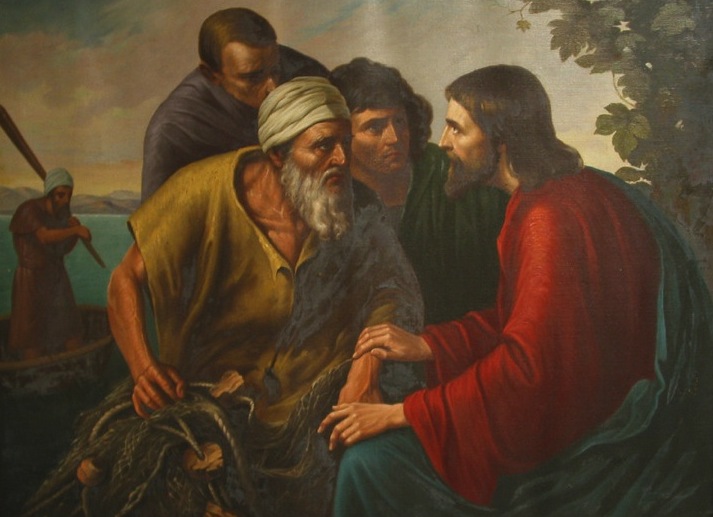 |
| Jesus with Peter, John, and James |
They kept silent and told no one in those days anything that
they had seen. What else could they have
done? Those whose minds are sealed in
the world of the crowds and crows and Caesars are seldom impressed with tales
of glory. And even if they be enchanted,
they ponder the unearthly, rarely imagining that transfiguration or any such
thing could be for them. Peter, James,
John, their fellow disciples, and countless others were soon to come to see
something more magnificent than the Transfiguration, namely Jesus’ Easter, his
spring, his Resurrection. They would
only get there by
listening to him and following him on the road that led through Gethsemane to Calvary, through agony and death. But they would catch on in due time to the
fact that what had happened to Jesus on the mountain was their destiny
too. Time would come when they would
tell freely what they had seen there, convinced that the world of the divine
penetrates the world of the crowds on every level. The day would dawn when they and their
sisters and brothers would be the community showing what could happen to the
world when it but listens to the Chosen One, takes up its cross, and follows
him in the way that seeks Love in an exhilarating journey where there are no
guardrails, only grace.
 |
| The road up Mt. Tabor |
A sermon for the Last Sunday after Epiphany, Year C of
the Revised Common Lectionary
Luke 9:28-36
© Frank Gasque Dunn, 2013, 2019


